 Aphing Marie-Joseph
Summarize this blog post with :
How can you improve your visibility in AI search engines like ChatGPT, Google AI Mode, Copilot and Perplexity?
Hi, I'm Eric Waterschoot. My name is Eric Waterschoot. And as an AI strategist, I get this question almost daily.
While Google remains the dominant way for people to discover information, a major shift is underway. Large language models (LLMs) like ChatGPT, Google's AI mode, Copilot, Perplexity and DeepSeek are increasingly being used as primary discovery engines, not just assistants.
Users now expect :
- Direct answers instead of link lists
- Contextual explanations instead of keyword matches
- Reliable recommendations instead of endless scrolling
For website owners, this means one thing: SEO is moving towards GEO (Generative Engine Optimization).
But GEO doesn't replace SEO. It builds on it.
From SEO to GEO: what's really changed?
GEO is often described as «the next version of SEO», but this formulation is misleading.
SEO doesn't disappear.
Generative engines still rely heavily on the same foundations that power traditional search.
The difference lies in the way content is selected and presented.
Traditional SEO aims to :
- Ranking pages in search results
- Capture clicks with visibility
GÉO aims to :
- Be quoted or referenced directly in AI responses
- Become a trusted source when AI systems summarize a topic
In practice, GEO relies on search engine optimizationadding an extra layer of authority, clarity and value to citations.
How do AI search engines explore and index content?
AI search tools don't necessarily use a specific «traditional exploration + index + classification» processes exactly like Google. Instead, they combine selective exploration, selected indexes and real-time retrieval to generate answers.
Unlike Google, which relies on Googlebot to continuously explore and index vast swathes of the open Web, most AI-based search tools maintain smaller, higher-quality indices.
In addition to stored cues, many AI systems also use recovery on demand. When a user asks a question, the AI can retrieve new content in real time, evaluate multiple sources and synthesize an answer (sometimes even if the content is not continuously indexed).
Different platforms approach this hybrid model in different ways:
- Perplexity AI uses PerplexityBot to explore selected sources, and also performs live retrieval at query time. This exploration behavior can sometimes bypass robots.txt and other traditional restrictions.
- Microsoft Copilot is based on the standard Bing index. This means that content visibility in Copilot largely depends on the quality of a site's indexing and ranking in Bing.
- Presentations of Google's AI and AI mode are based directly on the traditional Google index combined with live AI information.
- ChatGPT uses OpenAI exploration robots (GPTBot for training-related exploration and OAI-SearchBot for search indexing)which both respect robots.txt. Blocking these robots may limit indexing and quoting in ChatGPT Search (although content may still appear in replies if retrieved live at a user's request).
So, to ensure that your content is detectable in AI search :
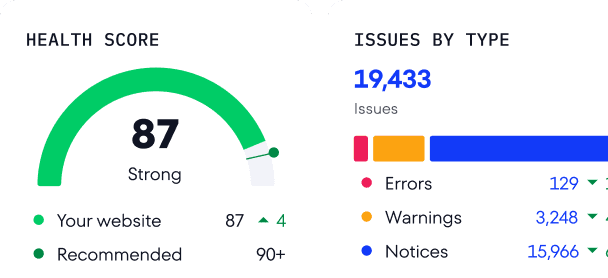
Ensuring page indexability - Confirm canonical tags, remove unnecessary 404 or noindex directives and maintain a clean site structure.
Use SE Ranking's website audit tool to detect technical SEO problems that could prevent IA search engines from indexing your content correctly.
However, exploration capacity alone does not guarantee AI visibility.
SE Ranking's research shows that files like LLMs.txt currently have little or no influence on how tools like ChatGPT or Google's AI mode select and cite content. Technical access is therefore a prerequisite, but not in itself a lever for AI visibility.
How to check your search engine visibility IA
AI tools such as ChatGPT, Copilot and Perplexity AI generate responses based on databases, live search results, memory and past interactions. This means your site's visibility can be influenced in unexpected ways. Always test anonymously and online to get a more realistic view:
- Use a private browser window instead of connecting to ChatGPT, Copilot or Perplexity AI.
- For DeepSeek, create a new account without search history.
But manual testing has its limits. AI tools can always customize responses based on session context, model updates and prompt structure, so results will always vary.
That's why SE Ranking has developed tools such as ChatGPT Visibility Tracker, AI Overviews Tracker, AI Mode Tracker, which can be invaluable for AI and SEO strategists like me. In concrete terms, they enable you to:
- Monitor which queries trigger your brand
- Track quotes over time
- Compare your visibility to that of your competitors
- Identify your most cited pages
This turns GEO from a conjecture into a measurable optimization.
What really drives AI citations (based on data)
To answer this question, SE Ranking recently analyzed :
- 129,000 domains and 216,000 pages for ChatGPT
- 295,000 domains and 2.3 million pages for AI mode
- Hundreds of thousands of AI prompts
- Over 50 ranking factors using XGBoost and SHAP analysis
And here are the factors that have the greatest impact on quotes in ChatGPT and AI Mode responses.
1. Domain authority
Authority is the strongest common denominator between AI platforms.
Sites that :
- attract quality backlinks
- earn referrals from trusted domains
- demonstrate long-term credibility
are far more likely to be cited by AI systems.
For ChatGPT in particular, the referent domains are the #1 ranking factor.
To give an example, sites with over 32,000 referring domains are 3.5 times more likely to be cited by ChatGPT than those with up to 200 referring domains.
2. Google visibility
AI systems do not operate independently of search engines.
Pages that are already performing well in Google :
- rank higher organically
- attract constant traffic
- maintain stable visibility
are much more likely to appear in Google AI mode responses.
Research data shows that websites with over 1.16 million visitors are 3 times more likely to be chosen as a source by AI Mode than those with fewer than 2.7,000 visitors.
This makes Google organic traffic is the #1 predictor of AI citations.
3. Brand strength and recognition
AI systems favor recognizable brands.
Strong signals include :
- Home page traffic
- Brand search volume
- Trademarks on Quora and Reddit
- Presence on review platforms (Trustpilot, G2, Capterra, Yelp)
For example, domains with millions of brand mentions on Quora and Reddit are around 4 times more likely to be cited by ChatGPT than those with minimal activity. For AI mode, reaching the point of 240,000 brand searches increases your chances of being cited by around 33 %.
4. In-depth, structured and regularly updated content
Pages that always work well:
- cover a topic from start to finish
- answer related sub-questions
- regularly review and update important pages
- use H2 for main themes, H3 for details
- use lists and tables where appropriate
- include quotes from experts, statistical information, etc.
are generally more likely to be cited in AI responses.
Research shows that content longer than 2,900 words works best for ChatGPT. For AI mode, this starts at 2,300 words.
What's more, for both AI systems, updating content every 2-3 months is considered an important ranking factor.
5. FAQ sections and question style titles
Including FAQs within the content helps AI identify clear answers.
- FAQ sections increase citation probability
- Question headings and H1s are useful, especially for small sites.
Important information:
FAQ diagram markup in itself, has no measurable impact on AI citations. Structure beats metadata.
A practical GEO action plan
1. Build and reinforce authority signals
- Earn mentions and backlinks from reputable and relevant websites
- Clearly identify content authors and their expertise
- Back up claims with credible sources, data or references
2. Maintain organic visibility on Google
- Give priority to high-traffic pages that are already attracting significant organic traffic
- Improve the average ranking positions of key URLs
- Maintain high visibility on home page and brand signals
3. Create in-depth, well-structured content
- Aim for at least 1,500 words for most subjects
- Use H1, H2 and H3 headings that the AI can interpret
- Divide your content into sections of 120 to 150 words between headings.
4. Strengthen your brand's presence beyond your website
- Participate in relevant discussions on platforms such as Reddit and Quora
- Establish a presence on review platforms such as Trustpilot, G2, Capterra, Sitejabber and Yelp.
- Share your content updates on all social platforms
- Engage with your community to show an active brand presence
Tools such as Plannable help maintain consistency without overburdening your team
What doesn't work to increase the visibility of AI research:
❌ LLMs.txt files
❌ Titles and URLs filled with keywords
❌ Rely only on schematic markup
❌ Thin or too generic content
❌ Focus only on one type of content
❌ Rely on a «trusted» domain zone such as .gov or .edu
❌ Ignore internal links
❌ Overloading pages with ads or pop-ups
Bonus tip: use AI follow-up questions to obtain information
AI tools like Perplexity and Copilot generate follow-up questions based on search queries. This reveals gaps in content that you can use as inspiration for new content:
- What related topics are users looking for?
- What FAQs are missing from my website?
- What details does the AI point out that I didn't?
- What would be the next logical step for my visitors?
SE Ranking's content editor helps you optimize this content for traditional search so you can generate more organic traffic from Google.